Loading cart contents...
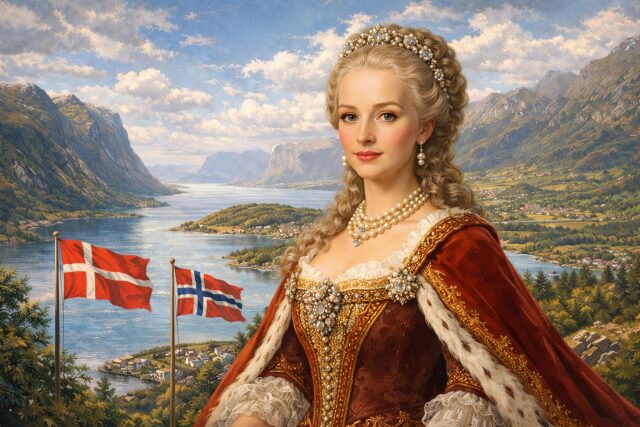
Elisabeth Oldenburg of Denmark and Norway as a Gateway Ancestress to the Progenitors of the Giske-Clan
Elisabeth Oldenburg of Denmark and Norway is presented as a gateway ancestress whose remarkably dense ancestry leads back to the early progenitor lines of the Giske-Clan. Through both her paternal Oldenburg line and her maternal Mecklenburg line, the article traces separate descents to Tora Torsteinsdatter Galge and the wider Arnungane of Giske.
The Giske-Clan of Giske and the Arnungane
In the broader sense used here, the Giske-Clan is the whole Arnungane—literally “Arne’s children”—the descendants of Arne Arnmodsson of Giske and Tora Torsteinsdatter Galge. In that wider historical and genealogical understanding, the line is not confined to the narrower later Giskeætten from Finn Arnesson, Torberg Arnesson, Kalv Arnesson as the most famous + Ragnhild Arnesdatter, Kolbjørn, Arne, Arnbjørn and Aamund, and their siblings, and the other children of that great eleventh-century house. Store norske lexicon treats the Arnmødling circle as one of the major aristocratic kin-networks of early medieval Norway, and that is the sense in which this essay uses the term Giske-Clan.
The Oldenburgs: A Northern Royal House
The House of Oldenburg was one of the great ruling dynasties of northern Europe. Britannica and Lex both note that the dynasty rose to major prominence when Christian I of Oldenburg became king of Denmark in 1448 and Norway in 1450, after which Oldenburg rulers remained central to Danish-Norwegian monarchy for centuries. By the sixteenth century, an Oldenburg princess could stand at the crossroads of Scandinavian kingship, German princely houses, and a remarkably deep reservoir of medieval ancestry.
Elisabeth Oldenburg (1573-1626) and Her Marriage
Elisabeth Oldenburg, better known in Danish history as Elisabeth of Denmark, was born at Koldinghus on 25 August 1573 as the eldest daughter of Frederick II of Denmark and Norway (1534-1588) and Sophie of Mecklenburg-Güstrow (1557-1631). She married Henry Julius, Duke of Brunswick-Wolfenbüttel (1564-1613) in 1590, and thereafter moved into the orbit of the north German duchies, where she became an important dynastic link between the Danish crown and the Protestant princely courts of the Empire. Danish Biographical Lexicon dates her death to 19 July 1626 in Braunschweig, although some compiled genealogies give 1625; the Danish lexicon is the stronger source here.
Elisabeth matters not only because she was a Danish princess, but because she belonged to a generation in which aristocratic pedigrees had become exceptionally dense. As my research show, both her father’s side and her mother’s side independently lead back to Tora Torsteinsdatter Galge of Giske. That means Elisabeth is not just another royal descendant with one distant Nordic line: in our framework, she is a woman through whom multiple converging lines return to the same Giske progenitors. Giske are the root of all european royals through all times I have documented in this metastudy. The common denomiator for all royals of Europe.
If you like your personal ancestry chart to the Giske-Clan,
contact me as I offer that as a service, normally USD 600
(price estimate if you already have an idea you belong to a gateway ancestor)
Her Father: Frederick II (1534-1588) and the Paternal Route Back to Giske
Elisabeth’s father, Frederick II (1534-1588), was king of Denmark and Norway from 1559 until his death. Britannica describes him as the ruler who, despite setbacks in the Northern Seven Years’ War, preserved Danish strength in the Baltic and oversaw a period of prosperity. Lex adds that he was the son of Christian III (1503-1559) and Dorothea of Saxe-Lauenburg (1511-1571), and that in 1572 he married Sophie of Mecklenburg.
Your attached paternal chart traces Frederick II’s ancestry back through Dorothea of Saxe-Lauenburg, Catharina of Brunswick-Wolfenbüttel, Katharina of Pomerania-Wolgast, the Folkung line, and then farther north into Jorunn Torbergsdotter Giske, Torberg Arnesson of Giske, and Tora Torsteinsdatter Galge. In other words, Elisabeth inherited one Giske line through the Danish royal Oldenburg side itself. The chart presents that paternal descent as a direct line to Tora Torsteinsdatter, and in the Giske-Arnung sense that places the line squarely inside the ancestral blood of the clan’s progenitors.
Her Mother: Sophie of Mecklenburg-Güstrow (1557-1631) and the Maternal Route Back to Giske
Elisabeth’s mother, Sophie of Mecklenburg-Güstrow (1557-1631), was one of the most formidable royal women of her age. Lex and Danish biographical sources describe her as queen of Denmark and Norway from 1572 to 1588, daughter of Ulrich III of Mecklenburg-Güstrow (1527-1603) and Elisabeth of Denmark (1524-1586), and later one of the richest and most politically capable dowager queens in northern Europe. She was not a passive consort; she became a major landholder, financier, and dynastic strategist in her own right.
The maternal chart you attached traces Sophie of Mecklenburg back along another line to the same Giske beginnings. It runs through Sophie of Pomerania, Sachsen-Lauenburg, the Swedish Folkungaätten, and then to Jorunn Torbergsdotter Giske, Torberg Arnesson, and Tora Torsteinsdatter Galge. So Elisabeth did not receive her Giske connection from one side only. She received it from both parents, through two separate dynastic pathways that converge on the same early Norwegian ancestral house.
Why Elisabeth Oldenburg Matters
That double descent is what makes Elisabeth Oldenburg especially striking. Many late sixteenth-century royal women have impressive pedigrees, but Elisabeth stands out because the two lines you attached already show independent paternal and maternal descents to the same Giske progenitor line. For a woman born in 1573, that is an unusually rich example of dynastic concentration: Scandinavian royal blood, German princely blood, Oldenburg kingship, Mecklenburg, Pomerania, Sachsen-Lauenburg, and the earlier northern aristocratic stream all interwoven in one person.
She therefore works very well as a gateway ancestress to the progenitor lines of the Giske-Clan. Through Elisabeth, one begins with the visible grandeur of the Oldenburg monarchy of Denmark and Norway, then moves outward into the princely houses of northern Germany and Sweden, and from there backward into the older Norwegian world of Torberg Arnesson, Tora Torsteinsdatter Galge, and the wider Arnungane. She is not merely a descendant of kings; she is a dynastic meeting point where several later royal houses feed back into the same early Giske origins.
Conclusion
For that reason, Elisabeth Oldenburg of Denmark and Norway (1573-1626) is a particularly strong subject in a series on gateway ancestresses to the Giske progenitors. She was born an Oldenburg princess, married into the Brunswick-Wolfenbüttel ducal house through Henry Julius (1564-1613), and carried into that marriage an extraordinarily dense pedigree. Most importantly for your project, the two lines you attached show that both her father’s and mother’s ancestry independently return to Tora Torsteinsdatter Galge of Giske. In the broader Arnung sense, that makes Elisabeth not just another high-born descendant of medieval royalty, but a genuine gateway figure back to the early bloodlines from which the Giske-Clan emerged.
Tora Torsteinsdatter Galge bloodline leads direct into Fairhair and Queen Victorias bloodline. And that from this Norwegian royal family opens the door into the Biblical family of the “Lost” 10 Tribes of the Israelites; King Davids (Perez line) and Judah ben Isaacs seed. You can find lots of book documenting that here in our book store.