Loading cart contents...
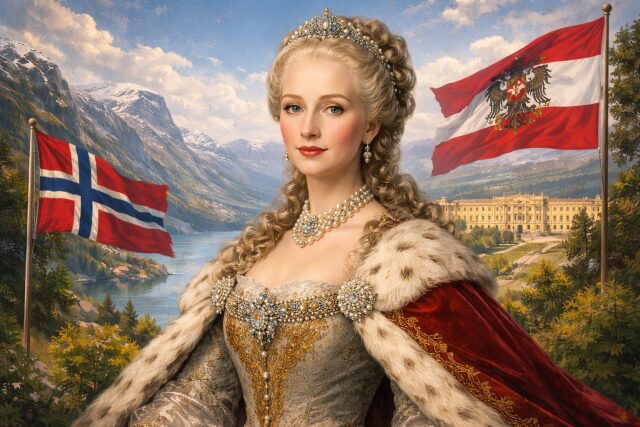
Maria Theresa Habsburg, Archduchy of Austria, to the Giske-Fairhair Progenitors
Maria Theresa Habsburg is presented as a gateway ancestress whose lineage links the imperial House of Habsburg to the older Scandinavian bloodlines of the Giske-Clan. Through her paternal Fairhair-linked ancestry and her maternal Brunswick-Welf line reaching back to Tora Torsteinsdatter Galge and the Arnungane of Giske, the article places her within the wider Giske royal tradition.
The Giske-Clan of Giske and the Arnungane
In the broader sense used here, the Giske-Clan is not limited to the narrower medieval Giskeætten descending from Torberg Arnesson alone. It is the wider Arnungane—literally “Arne’s children”—the descendants of Arne Arnmodsson of Giske and Tora Torsteinsdatter Galge. In that older and wider understanding, Finn Arnesson, Torberg Arnesson, Kalv Arnesson as the most famous + Ragnhild Arnesdatter, Kolbjørn, Arne, Arnbjørn and Aamund, and their siblings all belong to the same great ancestral house. Store norske leksikon describes the Arnmødling kin as one of the highest-ranking networks in the Norwegian coastal aristocracy of the eleventh century, and identifies Finn and Torberg as leading members of that circle.
In my research perspective, that broader Arnung identity is essential. It means that when a later royal or princely line reaches back to Finn Arnesson or to the household of Arne Arnmodsson and Tora Torsteinsdatter, it reaches not merely into a collateral branch beside Giske, but into the full Giske-Clan itself. One of the pedigree charts you attached presents Maria Theresa’s maternal line as descending from Tora Torsteinsdatter Galge down to Maria Theresa through later Scandinavian and German princely houses, while the other presents her paternal side through Charles VI as descending from Harald Fairhair.
The Habsburgs: Europe’s Great Royal House
Few dynasties shaped Europe more lastingly than the House of Habsburg. Britannica describes the Habsburgs as one of the principal sovereign dynasties of Europe from the fifteenth to the twentieth century. They ruled Austria from 1282 to 1918, controlled Bohemia and Hungary from 1526, and for long stretches also ruled Spain and its empire. Their power grew not only by war but by dynasty: by marriages, inheritances, and the patient accumulation of crowns. In that sense they were not merely one royal family among many, but the great continental royal house of later Europe.
Maria Theresa stands at the center of that inheritance. She was born in Vienna on 13 May 1717 and died there on 29 November 1780. She was the eldest daughter of Charles VI (1685-1740) and Elisabeth Christine of Brunswick-Wolfenbüttel (1691-1750), and after her father’s death she became ruler of the Habsburg Monarchy. Habsburger.net describes her as Queen of Hungary and Bohemia and Archduchess of Austria, while Britannica emphasizes that she gave the Habsburg monarchy a new measure of unity and strength.
If you like your personal ancestry chart to the Giske-Clan,
contact me as I offer that as a service, normally USD 600
(price estimate if you already have an idea you belong to a gateway ancestor)
Maria Theresa (1717-1780) and Her Marriage
Maria Theresa was not an empress merely by pedigree; she was one of the great ruling figures of the eighteenth century. In 1736 she married Francis Stephen of Lorraine (1708-1765), later Francis I, Holy Roman Emperor. Britannica notes that the match was a love marriage, although it was entangled in the diplomatic settlement that forced Francis Stephen to surrender Lorraine and accept Tuscany instead. Their union founded the House of Habsburg-Lorraine, and together they had sixteen children, among them Joseph II, Leopold II, and Marie Antoinette.
Maria Theresa also mattered as a ruler in her own right. When Charles VI died in 1740, her succession triggered the War of the Austrian Succession, because the European guarantees surrounding her inheritance proved much weaker in practice than on paper. Yet she survived that crisis and went on to reform the army, state administration, taxation, and education. Habsburger.net notes that her reign brought a modernization push to the monarchy and that compulsory schooling in the hereditary lands was introduced in 1774.
Her Father: Charles VI (1685-1740) and the Paternal Royal Line
Maria Theresa’s father, Charles VI (1685-1740), was the last male of the direct Austrian Habsburg line. Britannica describes him as the author of the Pragmatic Sanction, the legal instrument designed to secure Maria Theresa’s succession when no surviving son remained. Habsburger.net likewise presents him as “the last Habsburg,” whose death left his daughter a weakened but still immense inheritance.
His wife was Elisabeth Christine of Brunswick-Wolfenbüttel (1691-1750), but through Charles himself but my research traces a much older northern line running back through medieval Scandinavian, Rus’, Lithuanian, Jagiellonian, and Habsburg connections to Harald Hårfagre Fairhair. That paternal chart is one reason Maria Theresa can be seen as a gateway ancestress not only to the high dynastic world of Central Europe but also to the older northern royal tradition.
Her Mother: Elisabeth Christine (1691-1750) and the Welf/Brunswick Bridge
On Maria Theresa’s mother’s side, the line enters another of Europe’s old ruling houses: the Welfs. Britannica describes the Welf dynasty as one of the great German ruling families, later producing the Hanoverian rulers of Great Britain as well. Elisabeth Christine herself was born in Brunswick on 28 August 1691, daughter of Louis Rudolph, Duke of Brunswick-Wolfenbüttel (1671-1735), and Christine Louise of Oettingen-Oettingen (1671-1747). She married Charles VI in 1708 and became Holy Roman Empress, Queen of Bohemia and Hungary, and Archduchess of Austria.
This maternal side is especially important for our Giske study, because we traces Elisabeth Christine’s ancestry back through Louis Rudolph, Elisabeth Juliane of Schleswig-Holstein-Sonderburg-Norburg (1634-1704), the Schleswig-Holstein and Sachsen-Lauenburg houses, the Swedish Folkung line, and ultimately to Tora Torsteinsdatter Galge of Giske. In other words, Maria Theresa’s mother is not only a Welf princess in the German sense; in our reconstruction she is also one of the carriers by whom older Scandinavian-Giske-Fairhair blood enters the later Habsburg world. The Habsburgs was Giske before they became Habsburg.
Dorothea of Denmark (1546-1617) and Dorothea of Brunswick-Lüneburg (1570-1649)
A particularly useful female bridge on that Brunswick side is Dorothea of Denmark (1546-1617). She was born at Kolding, the daughter of Christian III of Denmark-Norway and Dorothea of Saxe-Lauenburg, and in 1561 she married William the Younger, Duke of Brunswick-Lüneburg (1535-1592). Public sources describe her as Duchess of Brunswick-Lüneburg and later regent for her underage son George after her husband’s death. William, for his part, was a Welf ruler based at Celle, one of the principal dynastic centers of Brunswick-Lüneburg.
Their daughter Dorothea of Brunswick-Lüneburg (1570-1649) is one of the women rightly singled out as the gateway to the Giske-Clan. Public sources identify her as the daughter of William and Dorothea of Denmark, and as the wife of Charles I, Count Palatine of Zweibrücken-Birkenfeld (1560-1600). Through that marriage, the Welf-Brunswick line flowed onward into the Palatine and later German princely houses that ultimately lead toward Maria Theresa’s maternal ancestry. She is therefore one of the key female conduits by which the older northern-dynastic blood was carried forward into the eighteenth-century imperial house.
Ingeborg of Mecklenburg (1343-1395) as an Earlier Northern Hinge
Another important woman in the longer northern segment is Ingeborg of Mecklenburg (1343/45-1395). Public summaries identify her as daughter of Albert II, Duke of Mecklenburg, and Euphemia of Sweden, who herself descended from the Norwegian royal line. Ingeborg first married Louis VI of Bavaria (1330-1365), and after his death married Henry II, Count of Holstein-Rendsburg (c.1317-1390). Through her, Scandinavian royal blood passed into important German princely houses, and from there further into the dynastic mesh that would eventually help feed both Brunswick and Habsburg lines.
In our wider genealogical framing, figures such as Ingeborg of Mecklenburg and Dorothea of Denmark matter because they are not isolated names in a remote pedigree. They are hinge women: carriers of dynastic continuity, transmitting older Scandinavian and northern aristocratic blood into later continental houses. That is precisely the pattern that makes a gateway ancestress valuable in Giske research. My research are built around that kind of continuity.
Why Maria Theresa Matters for Giske Research
Maria Theresa matters because she stands at the meeting point of two vast worlds. On one side is the fully documented and historically unmistakable grandeur of the Habsburgs, Europe’s dominant dynastic house of the early modern age. On the other is the much older northern aristocratic world that, in my framework, runs back through Brunswick, Oldenburg, Mecklenburg, Swedish royal and princely lines, and ultimately into the Arnungane of Giske—and, through the paternal chart, into the wider Fairhair tradition as well.
That is why Maria Theresa is such a strong choice for this series. Katherine Lygon opened a path from Tudor England into the Giske-Clan through the border world of Britain and Scotland. Maria Theresa Habsburg (1717-1780) opens another, grander gate: from the imperial courts of Vienna and the European balance of power back into the older Scandinavian bloodlines that, in our research perspective, belong to the full Giske-Clan of Arne Arnmodsson and Tora Torsteinsdatter Galge. She is therefore not merely a famous empress with northern ancestry. She is a true gateway ancestress to the Giske-Clan progenitors.
Tora Torsteinsdatter Galge bloodline leads direct into Fairhair and Queen Victorias bloodline. And that from this Norwegian royal family opens the door into the Biblical family of the “Lost” 10 Tribes of the Israelites; King Davids (Perez line) and Judah ben Isaacs seed. You can find lots of book documenting that here in our book store.