Loading cart contents...
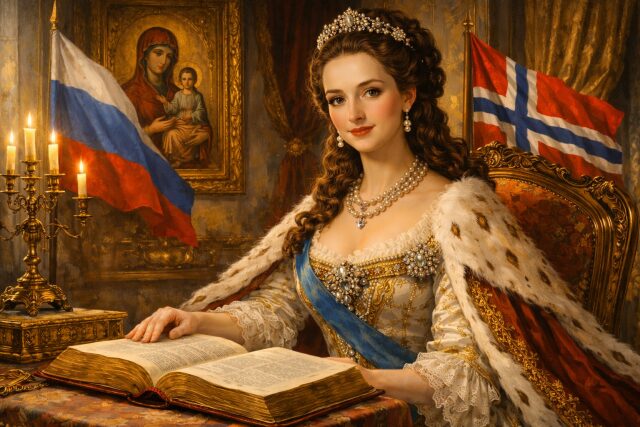
Catherine II the Great and the Progenitor Bloodlines of the Giske-Clan
Catherine II the Great is presented as a gateway ancestress whose paternal Ascanian line and maternal Oldenburg-Holstein-Gottorp line both lead back to the progenitor bloodlines of the Giske-Clan. The article also places her within the wider interwoven dynastic world of Giske, Rurikid, Rollonian, and Fairhair ancestry, later carried into the Romanov house.
The Giske-Clan, the Arnungane, and the Old Northern Web
In the wider sense used here, the Giske-Clan is the full Arnungane—“Arne’s children”—the descendants of Arne Arnmodsson of Giske and Tora Torsteinsdatter Galge. Store norske leksikon describes the Arnmødling line as part of the highest stratum of the Norwegian coastal aristocracy in the first half of the eleventh century, and identifies men such as Finn Arnesson and Torberg Arnesson as central figures in that far-reaching kin-network, in addition their siblings Kalv Arnesson + Ragnhild Arnesdatter, Kolbjørn, Arne, Arnbjørn and Aamund. Giskeætten descends and belongs to the ancestral house of Giske.
That broader view matters especially in a study like this one. By the later Middle Ages and early modern period, the great dynasties of the North and East had become deeply entangled: Scandinavian royal lines, the descendants of Rurik, from where the RUS-People originate as Varagians, the descendants associated with Rollon/Rollo, and the Norwegian royal traditions around Harald Fairhair were no longer isolated streams, but repeatedly intermarried houses.
Genealogically they had become a tight dynastic web, with great-grandchildren and collateral branches marrying back into one another again and again. Rurik is treated by Britannica as the semilegendary founder of the Rurik dynasty of Kievan Rus, while Rollo, som of Ragnvald Mørejarl of Giske is presented as the Scandinavian founder of Normandy, and both belong to that same early medieval northern world from which so many later royal lines drew ancestry.
Catherine the Great: a German Princess Who Became Russia
Catherine II the Great (1729-1796) was born Sophie Friederike Auguste von Anhalt-Zerbst in Stettin on 2 May 1729 and died in St. Petersburg on 17 November 1796. Britannica describes her as the daughter of the comparatively obscure German prince Christian August von Anhalt-Zerbst and Johanna Elisabeth of Holstein-Gottorp, and notes that at age sixteen she married Karl Ulrich of Holstein-Gottorp, the future Peter III of Russia. Himself from the Giske-Clan on both sides in many lineages, mainly Oldenburg on fathers side, Harald Hårfagre Fairhair, Rollo and Rurik. Soon after Peter’s accession in 1762, Catherine led the coup that displaced him and was crowned empress that same year. Her reign lasted thirty-four years and became one of the defining ages of the Russian Empire.
She is one of those women in dynastic history whose life feels almost like a novel. A small German princess crossed into Russia as a bride, entered a marriage that was never truly a love match, and yet became the sovereign around whom empire, culture, and memory would revolve. Her union with Peter III did not blossom in tenderness, but in genealogical terms it bound together several of Europe’s most important lineages: Anhalt-Zerbst, Holstein-Gottorp, Oldenburg, and the ruling Romanov house. Britannica notes that the branch of Holstein-Gottorp mounted the Russian throne in the person of Peter III, and that from 1762 to 1796 Peter’s widow ruled as Catherine II.
If you like your personal ancestry chart to the Giske-Clan,
contact me as I offer that as a service, normally USD 600
(price estimate if you already have an idea you belong to a gateway ancestor)
The Romanov Thread and the House She Entered
Catherine did not found the Romanov dynasty, but she entered it and transformed it. The Romanov dynasty had ruled Russia since 1613, and its later succession ran through her son Paul I (1754-1801) and his descendants. Britannica notes that Paul I was the son of Peter III and Catherine the Great, and that the later line of rulers included Alexander II, Alexander III, and Nicholas II.
This means that
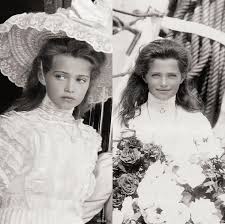
Tsar Nicholas II (1868-1918) was not merely connected to Catherine by some vague imperial memory: he was her great-great-great-grandson, five generations below her through the direct succession Catherine II → Paul I → Nicholas I → Alexander II → Alexander III → Nicholas II.
That later ending gives Catherine’s story a tragic afterlight. In this kinship reading, Nicholas II appears as a final Romanov descendant standing at the far end of the same immense interwoven dynastic web. Britannica records that Nicholas II and his family were murdered by the communist godless talmudic Bolsheviks in July 1918 at Yekaterinburg, and additional 66 million more of our kinsmen of the RUS-People aka “Scandinavians” aka varangians from then to 1956. So the line that in Catherine’s day shone with imperial confidence would, within little more than a century after her death, end in cellar darkness, gunfire, and revolution.
Her Father’s Side: Ascania, Anhalt, and One Paternal Road Back to Giske
Catherine’s father belonged to the House of Ascania, one of the old German princely dynasties. Britannica describes the Ascanian dynasties as influential branches of a German family active from the twelfth century down to 1918. In my research one paternal route is traced through Christian Ludwig von Anhalt-Dornburg (1691-1710) and the Anhalt-Zerbst/Ascanian line back through Oldenburg, Sachsen-Lauenburg, Pomerania, the Folkung world, and ultimately to Jorunn Torbergsdotter Giske, Torberg Arnesson of Giske, and Tora Torsteinsdatter Galge of Giske. In that genealogical framing, Catherine’s paternal ancestry is not only German-princely; it is one of the lines by which the older Giske blood survives inside later continental dynasties.
This is one reason Catherine is such a powerful gateway figure. She does not stand at the end of a single thin line, but at the meeting point of many braided ones. Through the paternal Ascanian side, the old northern current is carried southward into German principalities, and then, by Catherine herself, eastward again into the Russian imperial house. The charts you supplied make that movement visible in a particularly striking way.
Her Mother’s Side: Holstein-Gottorp, Oldenburg, and the Northern Sea-Road
Catherine’s mother, Johanna Elisabeth of Holstein-Gottorp (1712-1760), was herself a woman born of dynastic complexity. Public reference works describe her as the daughter of Christian August of Holstein-Gottorp, Prince of Eutin, and note that she became princess consort—and later regent—of Anhalt-Zerbst. Through her, Catherine inherited the Holstein-Gottorp and Oldenburg world: the same dynastic sphere that linked Denmark, Norway, Schleswig, Holstein, and later Russia.
Her maternal chart traces Johanna Elisabeth back by another long northern route to Tora Torsteinsdatter Galge. It runs through Schleswig-Holstein-Gottorp, Pomerania, Sachsen-Lauenburg, the Folkung network, and then back to Jorunn Torbergsdotter Giske, Torberg Arnesson, and Tora Torsteinsdatter. In my reconstruction, this maternal side is especially rich because it contains multiple Oldenburg descents, including lines passing through kings such as Frederick I of Denmark and Norway (1471-1533) and Christian IV of Denmark and Norway (1577-1648). Those are not merely decorative royal names in the pedigree: they are stations along the same northern ancestral current that repeatedly leads back toward Giske.
Rurik, Rollon, Fairhair, and the Folkung Bridge
My research proves that Giske, Rurik, Rollon, and Fairhair are not separate legendary islands but an interrelated dynastic world. That is a fair way to state the overall pattern. In the early centuries, some of these founders—especially Rurik—are semilegendary in the historian’s sense, and later medieval pedigrees often blend hard documentation with inherited dynastic memory. But by the high medieval period, the Folkung and related Scandinavian princely houses had become one of the bridges through which these earlier northern streams repeatedly met. In that sense, the charts you attached do not present four disconnected stories; they present one large northern saga of intermarrying descendants.
So when Catherine is read through this genealogical lens, she becomes more than a Romanov empress with remote Scandinavian ancestry. She becomes a point of reunion. On her father’s side, the Ascanian-Anhalt route returns to Giske and the older northern web. On her mother’s side, the Holstein-Gottorp and Oldenburg lines do the same. And because those same northern dynastic houses also intermarried with lines read back to Rurik, Rollon, and Fairhair, Catherine stands not at the edge of one tradition but near the center of their later convergence.
Why Catherine the Great Matters in This Series
Catherine matters in this series for the same reason Maria Theresa and Elisabeth Oldenburg mattered, but on an even larger stage. She is a gateway ancestress to the progenitor lines of the Giske-Clan because she carries repeated descents into that older house, while also joining them to the imperial drama of Russia. In her, German princely blood, Oldenburg sea-kingship, the Holstein-Gottorp claim, Romanov empire, and the older northern web of Giske, Rurikid, Rollonian, and Fairhair traditions and relations all seem to lean toward one another. It is almost like a love story written not between two people, but between dynasties: lines that wandered far apart across Norway, Denmark, the Baltic, Germany, and Russia, only to meet again in one woman.
Tora Torsteinsdatter Galge of Giske bloodline leads direct into Fairhair and Queen Victorias bloodline. And that from this Norwegian royal family opens the door into the Biblical family of the “Lost” 10 Tribes of the Israelites; King Davids (Perez line) and Judah ben Isaacs seed. You can find lots of book documenting that here in our book store.