Loading cart contents...
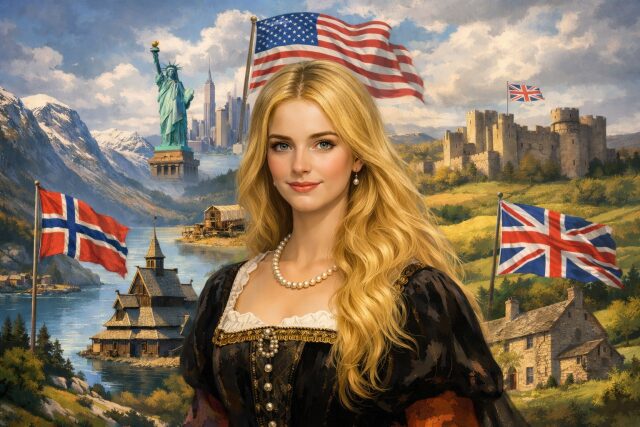
Katherine Lygon as a Gateway Ancestor to the Norwegian Giske–Fairhair Kindred
Katherine Lygon is presented here as a gateway ancestor whose bloodline links Tudor England to the older noble and royal worlds of medieval Britain and Norway. Through the Lygons, Beauchamps, St Johns, Lucys, and the Scottish royal house, her ancestry leads back to Ingebjørg Finnsdóttir and thus into the full Giske-Clan of Arne Arnmodsson of Giske (958-1024) and Tora Torsteinsdatter Galge (970-1015).
The article argues that, from the Arnungane perspective, this is a direct Giske lineage as on her father side she is direct to Giske-Fairhair and another related Giske-family, Ragnar Mørejarl of Giske / Rollon / William the Conqueror, and several of her mothers lines to the latter, so not merely a collateral branch. It also notes that a later branch of the family emigrated to Virginia, where the Lygon name became Ligon and rose to local prominence in colonial America.
The Giske-Clan of Giske and Its Fairhair Heritage
The Giske-Clan includes the whole Arnungane — literally “Arne’s children” — the descendants of Arne Arnmodsson of Giske and Tora Torsteinsdatter Galge. In this researchers perspective, all the children of that great household belong to the full Giske-Clan: Finn Arnesson, Torberg Arnesson, Kalv Arnesson as the most famous + Ragnhild Arnesdatter, Kolbjørn, Arne, Arnbjørn and Aamund, and their siblings. From this powerful kin-group emerged some of the most important aristocratic and political networks in medieval Norway, extending into Orkney, Scotland, and the wider North Atlantic world.
Within this lineage tradition, Tora Torsteinsdatter Galge is understood as carrying royal blood descending from Harald Hårfagre Fairhair, so that the Arnungane are not merely a local chieftain house, but part of the long stream of Norway’s early royal and noble blood. Whether viewed through saga tradition, aristocratic kinship, or later medieval memory, the Giske-Clan stands as one of the great historic kindreds of Norway.
It is in that full sense — the full Arnung-Giske sense — that Katherine Lygon becomes genealogically important.
If you like your personal ancestry chart to the Giske-Clan,
contact me as I offer that as a service, normally USD 600
(price estimate if you already have an idea you belong to a gateway ancestor)
Katherine Lygon as a Gateway Ancestor
In genealogy, a gateway ancestor is an ancestor through whom a later family enters a wider, already traceable world of medieval nobility, royalty, and well-preserved pedigree lines. Katherine Lygon is such an ancestor. Through her paternal ancestry, one passes from Tudor Worcestershire into the Beauchamps of Powick, the St Johns of Lageham and Stanton, the Lucys of Copeland, the princely house of Duncan II of Scotland, and finally into Ingebjørg Finnsdóttir, daughter of Finn Arnesson of Giske.
That point is crucial. Under the narrower definition of Giskeætten, Katherine’s line touches the close kindred of Giske through Finn, brother of Torberg. But under the broader and more original definition of the Giske-Clan as Arnungane, Katherine does not merely touch the family — she descends directly from it. Through Finn Arnesson, her bloodline runs straight into the very children of Arne Arnmodsson and Tora Torsteinsdatter Galge.
Thus Katherine Lygon is not only a gateway ancestor into English baronial and royal descent. She is also a gateway ancestor into the full Giske–Fairhair clan tradition.
Katherine Lygon in Tudor England
Katherine Lygon lived in the sixteenth century in Worcestershire, within the landed world of the English gentry. She belonged to the Lygon family of Madresfield, a house that would in later centuries become one of the best-known county families in the English Midlands. She was born into a family already respectable and well established, but what makes her especially valuable to genealogists is that her ancestry opens backward into much older, better documented medieval noble lines.
In her own lifetime, Katherine stood in the world of Tudor manor society: marriage alliances, local office, landholding, and inherited prestige. Yet behind that apparently local English setting lay a pedigree stretching far beyond Worcestershire — into baronial England, feudal Cumbria, medieval Scotland, Orkney, and Norway.
The Lygons and Their Rise Through Marriage
Katherine’s father was William Lygon of Madresfield, and the Lygons were a prominent Worcestershire family. But the decisive rise of the house came one generation earlier, when the Lygons married into the Beauchamps of Powick. (Beauchamp are another related Giske-family, Ragnar Mørejarl of Giske / Rollon / William the Conqueror). That marriage drew into the family a line of English barons and royal servants whose ancestry had already been woven into the upper nobility of medieval England.
This is a common pattern in gateway genealogy. A later gentry family may appear merely local at first glance, but once one generation is opened, the line suddenly expands into a network of titled houses, office-holders, landholders, and royal connections. Katherine Lygon represents exactly that kind of opening.
The Beauchamps of Powick
Through Katherine’s ancestry, the line passes into the Beauchamps of Powick, one of the important noble families of Worcestershire. These Beauchamps were men of rank, administration, and military service. They served kings, held castles, acted as sheriffs, and moved within the political world of late medieval England.
The Beauchamp generations are important not only because they were noble, but because they help bridge the transition from later medieval county aristocracy into the deeper baronial lines of England. Through them the pedigree continues into the St John family, and from there into even older landed houses.
The St Johns: From Barons to Ancient Manor Lords
Beyond the Beauchamps the line passes into the St Johns, especially the branch known as the Barons St John of Lageham. This brings the ancestry into the world of hereditary barons, manorial lords, and the network of families who shaped English political and territorial life in the thirteenth and fourteenth centuries.
The St Johns were not isolated. Their marriages linked them to other noble houses, and in Katherine’s line one of the most important of these links is to the Lucy family (direct related Giske-family, Ragnar Mørejarl of Giske / Rollon / William the Conqueror).
The Lucys of Copeland and the Northern Border World
Through Cecily de Lucy, the pedigree moves out of the southern English baronial world and into the old northern frontier society of Copeland and Allerdale, where English, Norman, Scottish, and Norse influences met. The Lucys were powerful in the north-west of England, and through marriage they inherited blood descending from the Scottish princely line.
This northern section of the pedigree is especially important because it is here that the line begins to shift from English feudal nobility into the royal and semi-royal world of medieval Scotland.
William fitz Duncan and the Scottish Royal Connection
Cecily de Lucy’s ancestry leads back to Amabel fitzWilliam, daughter of William fitz Duncan. William was no ordinary nobleman. He was a Scottish prince, the son of Duncan II of Scotland, and one of the great territorial magnates of the north. He held influence in Moray and northern England and married Alice de Rumilly, thereby uniting royal Scottish blood with major northern English estates.
William fitz Duncan is one of the strongest historical figures in the line. With him the ancestry clearly stands inside the orbit of the Scottish crown.
Duncan II and the House of Malcolm Canmore
William’s father, Duncan II, was king of Scotland for a brief and turbulent period in 1094. His reign was short, but his bloodline endured. Through him the line rises into the house of Malcolm III Canmore, one of the major kings of medieval Scotland.
And it is here that the line reaches its great northern hinge: Ingebjørg Finnsdóttir.
Ingebjørg Finnsdóttir: The Northern Hinge of the Bloodline
Ingebjørg Finnsdóttir is the key figure who binds the Scottish royal house to the Giske-Clan. She was the daughter of Finn Arnesson, one of the sons of Arne Arnmodsson of Giske and Tora Torsteinsdatter Galge. She first married Thorfinn Sigurdsson, Earl of Orkney, one of the most powerful rulers in the Norse world west of Norway, and later became associated with Malcolm III of Scotland, through whom she was mother of Duncan II.
Ingebjørg stands at the meeting point of three great worlds: the Norwegian aristocracy, the Norse earldom of Orkney, and the Scottish royal house. Through her, Katherine Lygon’s line passes directly into the blood of the Arnungane of Giske.
And because the Arnungane are here understood as the full Giske-Clan, Katherine’s relationship to Giske is not distant or symbolic. It is lineal and real.
Finn Arnesson and the Full Arnungane
Finn Arnesson was one of the most famous of the sons of Arne Arnmodsson and Tora Torsteinsdatter. He was a major chieftain, an aristocrat of consequence, and one of the leading men of eleventh-century Norway. He belonged to a sibling group whose collective influence was extraordinary. His brothers and sisters married into the highest circles of Norwegian and North Atlantic power.
This is why the broader perspective matters. If one defines the Giske family only as the descendants of Torberg Arnesson, then Katherine’s line belongs to a near branch. But if one defines the Giske-Clan correctly in the old Arnung sense — all the descendants of Arne and Tora — then Katherine descends from the core family itself.
She is therefore a descendant of the full Giske-Clan, not merely an adjacent cousin line.
Into United States of America
A later branch of the family crossed the Atlantic in the seventeenth century, and in America the surname was usually written Ligon rather than Lygon.
The key emigrant was Colonel Thomas Ligon, a member of the Madresfield-connected family, who came to Virginia in the early 1640s and soon settled in Henrico County. There he acquired substantial landholdings near the Appomattox River, served as a burgess for Henrico, held militia rank, and worked as a county surveyor, showing that the family quickly became part of the colonial governing class rather than remaining obscure newcomers.
Later family histories consistently remembered him as the founder of the American branch and traced his descendants widely across the United States. Thus, the Lygons not only rooted themselves in England’s county society, but also established a durable and influential offshoot in early Virginia, from which the American Ligon family grew. That makes Virginia not just the family’s first American foothold, but the base from which the American Ligon line established itself in colonial public life.
Why Katherine Lygon Matters
Katherine Lygon matters because she is a genealogical bridge between worlds. In her, Tudor England meets medieval baronial England; baronial England meets the northern border aristocracy; the border aristocracy meets the Scottish royal house; and the Scottish royal house meets the Norse-Gaelic and Norwegian aristocratic world of Orkney and Giske.
Through her line, one can follow blood and kinship from Madresfield back to Powick, from Powick to Lageham and Stanton, from there to Copeland, from Copeland to the Scottish crown, and from Scotland to Ingebjørg Finnsdóttir, Finn Arnesson, and the great household of Arne Arnmodsson of Giske and Tora Torsteinsdatter Galge.
That is what makes Katherine Lygon a true gateway ancestor. She opens not only the gates of English aristocratic genealogy, but also the gates into the Giske–Fairhair clan tradition itself.
Conclusion
Seen from the Arnungane point of view, Katherine Lygon’s significance becomes even greater than in a narrower pedigree reading. She is not merely descended from a family related to Giske. She descends from Finn Arnesson, one of Arne’s own children, and therefore from the direct bloodline of the Giske-Clan.
For that reason, Katherine Lygon should be understood as a gateway ancestor not only to English and Scottish nobility, but to the older Norwegian aristocratic and royal tradition centered on Giske, and, in this lineage understanding, ultimately connected to the Fairhair heritage carried through the house of Tora Torsteinsdatter Galge, who connect into the same bloodline as Queen Victoria was so proud of, direct to Zerah ben Jacob-Israel and Perez ben Jacob-Israel, sons of Judah ben Issac.
And that from this Norwegian royal family opens the door into the Biblical family of the “Lost” 10 Tribes of the Israelites; King Davids (Perez line) and Judah ben Isaacs seed.