Loading cart contents...
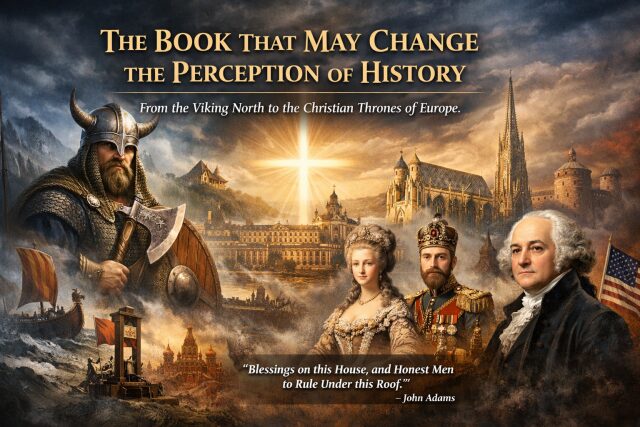
The Book on the Habsburgs That May Change the Perception of History
What if one of Europe’s greatest dynasties has been misunderstood from the beginning? What if the story of the Habsburgs does not start merely in Austria, Spain, palaces, and imperial ceremony, but much further north — in the older world of Giske, Fairhair, Rollo, and Rurik, in the world of the Viking progenitors, and in the long civilizational calling that later flowered under Christian law, kingship, and order?
That is the bold claim behind The Habsburgs and the Nordic Spirit in Their Blood: Dynasty, Biblical Kingship, and the Fate of Christian Europe. It is a book that does not simply retell dynastic history. It challenges the reader to rethink the history of Europe itself — politically, spiritually, genealogically, and biblically.
Now for sale here: https://www.norvision.no/product/the-habsburgs-and-the-nordic-spirit-in-their-blood/
Habsburgs with their Viking progenitors, the same vikings that should not be remembered only as destroyers at the edge of history, but also as ancestral carriers of the lines that later helped build Christian Europe under law, kingship, and Gospel civilization from Gulating in 1024 the basis for Great Britains magna carta (1216) and US Bill of Rights (1791) was institutionalized.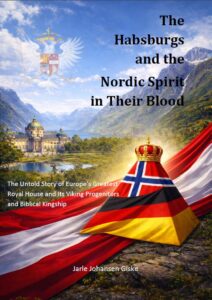
What history ordinarily calls the House of Habsburg is named according to the patriarchal custom of European dynastic memory. But a house-name is not the whole of ancestry. Children come from both father and mother, and over centuries the maternal lines become decisive in the actual biological and ancestral substance of a dynasty. In that deeper sense, the Habsburgs may be called Habsburg by dynastic name, yet increasingly Giske and Nordic in ancestral structure, because without the repeated contribution of those mothers, the later house would not have become what it was.
Not Just Another Habsburg Book
There are many books about the Habsburgs. There are books about emperors, marriages, wars, Vienna, Spain, and the decline of monarchy. But this book moves in another direction.
Its argument is that the House of Habsburg should not be seen only as an Austrian or continental imperial house. It should be seen as one of the greatest later concentrations of a deeper Nordic-Christian inheritance. Beneath the visible Habsburg grandeur stood a much older ancestral current: the northern royal web of Giske, Fairhair, Rollo, and Rurik.
That alone is enough to make the book original. But its challenge goes even further.
This is not only a genealogical thesis. It is also a civilizational one. The book argues that Europe flourished when it lived under Christ, law, inherited duty, family continuity, and rulers accountable to God, and that Europe declined when it revolted against that order.
A New Way to See the Viking World
Modern popular culture has done immense damage to the image of the Viking age. The Viking world is too often reduced to mud, chaos, rage, cruelty, and spectacle — entertainment for streaming audiences who are taught to see the North as savage before “real civilization” arrived elsewhere.
This book argues the opposite.
It presents the Viking progenitors not merely as raiders, but as founding families, law-carrying royal lines, sea-kings, settlers, dynastic transmitters, and, in time, participants in the Christian remaking of Europe. It does not deny violence. The world was violent everywhere. The law of the jungle was close to the surface in every land. But out of that same northern world came one of the great turning points in European history: the movement from force to law under Christ.
That is why the book places such weight on Gulating in 1024. In its argument, Gulating was not only a Norwegian legal moment. It was one of the seedbeds of a new Christian order: law above appetite, ruler under God, inheritance protected, society ordered by justice rather than by raw force alone. From there, the book traces a long constitutional spirit that later reappears more explicitly in landmarks such as Magna Carta and, still later, the Bill of Rights.
Whether one agrees with every step or not, the result is intellectually striking: the Viking world is no longer a barbarian prelude to “real history.” It becomes part of the making of Christian Europe.
The Family of the North and the Biblical Mandate
One of the most provocative aspects of the book is the way it joins genealogy with biblical history.
This is not done in the shallow modern sense of bloodline vanity. The point is larger. The book argues that biblical history did not end in abstraction. The promises to Abraham, Judah, David, and the coming of Christ worked themselves out visibly in nations, kings, houses, and lines. In that framework, the northern royal families are not random actors at the edge of history. They become participants in the historical movement by which Christian civilization was carried outward.
This is where the book’s language about mandate becomes central.
Its thesis is that the peoples and families of the North were not merely conquerors or wanderers. They became, in time, carriers of a calling: to receive Christ, to build under Christ, and to spread the Gospel and its civilizational fruits into the wider world. In that sense, the Viking progenitors are reinterpreted not as enemies of Christian order in the final meaning of history, but as eventual bearers of it.
That is one of the deepest ways this book changes historical perception: it relocates the North from the margins of civilization to one of its great ancestral engines.
A Different Way to Read the Habsburgs
The book also asks us to see the Habsburgs differently.
They are not treated merely as political opportunists or marriage technicians. They are presented as one of the great visible dynasties through which Christian Europe took public form. The old language of kingship under God, stewardship, dynastic continuity, sacred order, law, and civilizational burden is restored to the story.
And yet the book is not sentimental.
It does not end in palace nostalgia. It turns into warning.
In its reading, the destruction of Christian monarchy in France and Russia was not simply a political realignment. The killings of Marie Antoinette and Tsar Nicholas II become signs of a deeper revolt against throne, altar, inheritance, and sacred continuity. Once Europe rejected the order that had formed it, the result was not liberation in the highest sense, but dissolution, ideological fury, bloodshed, decay, and, eventually, civilizational exhaustion.
That warning is one of the book’s strongest features. It is not just about the past. It is about now.
Appendix H and the Hidden Pattern
One of the most suggestive parts of the project is Appendix H — Habsburg Marriages into the Nordic Royal Web.
The appendix does not function as romance or fantasy. It is meant as documentary support for a recurring pattern: that from an early stage, the Habsburg line repeatedly received women from the wider Nordic royal world. That pattern matters because dynasties do not move only through men and crowns. They move through wives, daughters, bridge women, maternal lines, and inherited blood.
The significance of Appendix H is therefore larger than one appendix table. It points to one of the book’s most important arguments: that the Habsburgs did not simply become great in isolation. They repeatedly drew into themselves the blood and inheritance of the North.
The book does not need to reveal every line in order to make that point felt. It is enough to know that the pattern is there, and that it invites the reader to rethink where Europe’s great house really came from.
Why This Book Matters Now
What makes this book especially powerful is that it is not only about ancestry. It is about memory.
It asks what happens to a civilization when it forgets who it is, who formed it, what moral order made it strong, and under what God it once stood. It argues that Europe and the wider West did not become great by accident, nor by material power alone. They were shaped by a spiritual architecture: Christ, family, kingship under God, law above rulers, inherited duty, disciplined households, and a deep civilizational seriousness.
When that inheritance was rejected, decline followed.
That is why this book reads at times like a historical study, at times like a manifesto, and at times like a warning addressed to the present age.
It does not ask the reader merely to admire the Habsburgs. It asks the reader to reconsider the whole moral and historical map of Europe.
A Book That Opens a Forbidden Question
The greatest strength of this work may be that it opens a question modern culture does not want asked:
What if the peoples now mocked as “barbarian” carried, in fact, some of the deepest ancestral and civilizational foundations of Christian Europe?
And what if the fall of Europe began when it abandoned not only Christ, but also the families, lines, laws, and inherited order through which Christendom had once been built?
That is why this book may genuinely change the perception of history.
Not because it flatters the past.
Not because it romanticizes royalty.
But because it proposes that beneath the official story of Europe there lies another one — older, stranger, more biblical, more northern, and perhaps closer to the truth.