
Loading cart contents...
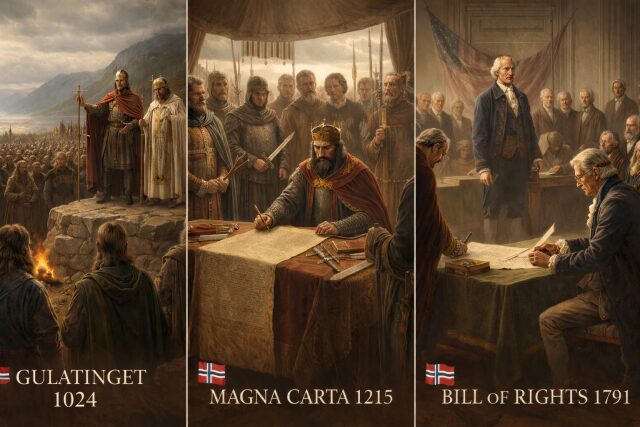
The Nordic Spirit from Gulatinget 1024 in the British Magna Carta and U.S. Bill of Rights
Gulating Christian law forms basis of Magna Carta and the U.S. Bill of Rights. The constitutional spirit later expressed in Magna Carta and the Bill of Rights was already present in substance at Gulatinget in 1024, and from there it entered the longer North Atlantic tradition, and formed the success of western civilization.
In my reading, the old Norwegian “kristenrett” Christian Law established a law-order in which the ruler stood under God and under law, where the purpose of justice was to protect the people from arbitrary power, and where political authority was bounded rather than absolute. The official Moster 2024 materials describe kristenrett as a shift “from power to law,” and explain that with Christianization, right was no longer grounded in raw strength but in a norm above men, giving the individual legal protection. They also note that this reduced the master’s power over the slave, that the rulers should be servants as in Christian principles and not emperors after herodic priciples, “might is right” should be dissolved.
My claim is not merely that the Gulating Christian law of 1024 belongs to the same moral universe as Magna Carta and the U.S. Bill of Rights. My claim is stronger: As a social contract Gulating formed the basis of Magna Carta and the Bill of Rights in spirit, principle, and constitutional direction. Not that every clause was copied word for word. But the governing idea was already there: law must stand above ruler, the state must be bounded, the people must be protected against arbitrary power, and justice must serve the household and the free person rather than the appetite of kings.
Earlier than Montesquieu
That is why I reject the lazy modern story that this begins in any serious sense with Montesquieu. Encyclopaedia Britannica is correct that Montesquieu gave the first modern formulation of separation of powers in 1748. But modern formulation is not the same as real origin. Even Britannica notes earlier antecedents, including Locke and the English constitutional tradition. My point is that the underlying anti-absolutist instinct is older still. It is older than Enlightenment theory because it is rooted in Christian law and Christian anthropology: fallen men abuse power, therefore power must be restrained. Magna Carta itself is officially described by the UK Parliament as the first document to put in writing the principle that the king and his government were not above the law. My claim is that Gulating had already planted that civilizational seed.
Gulating 1024: law over force
The significance of kristenretten is not that it was a modern liberal charter. It was not. Its importance is deeper. It marked a decisive movement from a society where strength, kin-force, and custom could dominate, toward a society in which law claimed a higher authority than mere power. Moster 2024 explains that the 1024 Christian law regulated life from baptism to burial, from holy days to churchyards, from clerical duties to moral prohibitions. The Church of Norway’s summary adds the crucial point: the new laws stated that there exists something right independently of the surrounding power relations. That is a constitutional principle in embryo. It means the ruler does not define the good by will alone. The law answers to a higher order.
This is why I read Gulating not as an early expansion of state power, but as an early Christian limitation of power. The king was not above the law; the people were not made for the king; and public order was to be judged according to a standard outside human appetite. That is the constitutional heart of the matter.
Magna Carta: the same struggle in England
Magna Carta in 1215 was another stage in the same fight. Parliament says plainly that it was issued to prevent the king from exploiting his power and that it placed limits on royal authority by establishing law as a power in itself. That is the exact kind of principle I argue had already been established in substance in the Nordic Christian legal spirit. At Runnymede, the principle became more explicit and more political, but the core struggle was the same: is law a protection against arbitrary rule, or is law merely the ruler’s instrument? Magna Carta answered by binding the king. I claim that answer belongs to the same long tradition that begins at Gulating.
The Bill of Rights: protection against government
The same line appears again with special clarity in the U.S. Bill of Rights of 1791. The U.S. National Archives says it “spells out Americans’ rights in relation to their government,” guarantees civil rights and liberties to the individual, requires due process, and reserves undelegated powers to the states or the people. That is not the state protecting itself from the citizen. It is the law protecting the citizen from the state. My claim is that this is not a break from the older North Atlantic Christian legal inheritance, but one of its most mature expressions. What Gulating began, Magna Carta sharpened, and the Bill of Rights codified in more explicit institutional form.
- 1 Samuel 8:10–18 — warning against extractive kingship
- 1 Kings 12:4, 10–14 — heavy burdens provoke national fracture
- Deuteronomy 17:14–20 — the king must be under law
- Ezekiel 46:18 — rulers must not seize the people’s inheritance
- Matthew 22:21 and Romans 13:6–7 — taxes can exist, but within legitimate bounds
Rulers as servants, not Herodian emperors
At the heart of this tradition lies a Christian doctrine of rule that modern civilization has almost forgotten. In the Christian view, rulers are to be servants under God, not emperors after Herodian principles. Christ said plainly: “The rulers of the Gentiles lord it over them … It shall not be so among you” (Matthew 20:25–28; cf. Mark 10:42–45; Luke 22:25–27). The king in Deuteronomy 17:14–20 must place himself under God’s law and “not exalt himself above his brothers.” Samuel in 1 Samuel 8:10–18 warns that kings will seize sons, daughters, land, produce, and labor, reducing the people to servitude. That is the biblical anatomy of predatory state power.
Herod is the perfect symbol of the anti-Christian model of rule. He kills to secure his throne (Matthew 2:16–18), murders truth to preserve face (Mark 6:17–29), and accepts divine honors until God judges him (Acts 12:21–23). Against this stands the Christian ruler: not an idol of state, not a devourer of households, but a minister of justice. My claim is that the spirit of Gulating, Magna Carta, and the Bill of Rights is anti-Herodian. In all three, the deepest purpose of law is to humble power, not to deify it.
Courts must protect the people from power
This same principle extends to the judicial order. A judiciary worthy of the name does not exist to rationalize the desires of rulers. It exists to protect the people against arbitrary power. Parliament’s historical material on Magna Carta stresses its role in establishing that the monarch is constrained by law. The U.S. Bill of Rights does the same by protecting due process, jury trial, and the security of persons, houses, papers, and effects. My claim is that the same constitutional instinct already lay in the Christian legal order of Gulating: justice was not to become a weapon for the crown against the people, but a shield for the people against the will of those who governed.
Scripture does not deny that civil rulers may levy lawful dues, but it sharply warns against predatory government. Samuel tells Israel that the king will take sons, daughters, fields, vineyards, produce, and flocks, and make the people servants (1 Sam. 8:10–18). Rehoboam’s refusal to lighten the people’s burden shattered the kingdom (1 Kings 12:4, 10–14). The king is therefore not to exalt himself above his brethren, but to remain under God’s law (Deut. 17:14–20), and “the prince shall not take of the people’s inheritance by oppression” (Ezek. 46:18). Caesar may receive what is Caesar’s (Matt. 22:21), and rulers may lawfully receive tribute for real public duty (Rom. 13:6–7), but Scripture never permits the state to become a devouring power that eats up household, inheritance, and liberty.
Private property, free households, and limited government
This spirit also explains why private property is so central to the Christian constitutional tradition. Scripture protects property directly in the commandments against theft and coveting, and it condemns royal seizure in the story of Naboth’s vineyard. The Bill of Rights continues the same moral seriousness by protecting houses, papers, effects, due process, and compensation for takings. A people without secure property is a people permanently exposed to officials. A civilization that does not protect the home eventually makes every household dependent on favor from above. My claim is that the legal world descending from Gulating opposed that tendency by placing boundaries around both ruler and state.
1 Kings 21 about Naboth’s vineyard. Ahab abuses royal power to seize property he has no right to take.
Very strong for property rights and state confiscation.
Ezekiel 46:18 “The prince shall not take of the people’s inheritance by oppression…”

The same is true of work. “If any would not work, neither should he eat” (2 Thessalonians 3:10) is not cruelty. It is a moral principle of responsibility. In the older Christian-Nordic order, a man was not to be crushed by legislative barriers or bled dry by arbitrary state appetite. He was to work, provide, and build. In that sense, what later became the “American dream” at its best was not a cult of consumption. It was the social fruit of a civilization that honored labor, household independence, and the right to enjoy the fruit of one’s work under law.
Both the American constitutional tradition and the older Norwegian legal tradition treated the home as a protected sphere against intrusion from outside powers and people, “our home is our castle” comes from this nordic spirit.
In the United States, that appears constitutionally in the Fourth Amendment’s protection of “persons, houses, papers, and effects” against unreasonable searches and seizures; historically, the Fourth Amendment was closely tied to property and trespass concepts. House inquisitions was likely forbidden in Norwegian constitutions, unless in criminal cases (case must be heard before a judge first, ONLY if reasonable criminal suspicion, to avoid arbitrary access). Trespassing of private property could get the intruders legally shot, after Christian Law.
In Norway, older legal tradition likewise treated trespass into another man’s property and home as a serious offense, and the Constitution expressly said that everyone has the right to respect for their home and that searches of private homes may not be made except in criminal cases. So the principle is the same: the house is not the state’s domain, protected of trespassing, to use defensive force came through common law and statute, while the constitutional principle was that home and property stood under legal protection against intrusion.
If you are interested in genealogy books, you can find them in my bookstore here:

My genealogical claim
My argument is not only legal and theological. It is also genealogical. My research shows that the men behind both Magna Carta and the Bill of Rights tradition were in significant measure of Giske–Fairhair ancestry. I hold that 16 of the 25 Magna Carta barons descend in that line, and that the same extended constitutional bloodline reaches into the American founding through men such as Benjamin Franklin, John Adams, and George Washington. That is my claim. On that basis, I do not see Gulating, Magna Carta, and the Bill of Rights as disconnected constitutional accidents. I see them as stages in a long historical continuity of Christian law, aristocratic responsibility, and anti-absolutist statecraft.
What Chinese intellectuals saw that the West is forgetting
This becomes even more striking when we consider how outsiders have judged the West. In the modern West, elites work feverishly to erase Christianity from public memory and public life. Yet one of the most arresting observations about Western success came from Chinese intellectual circles. Christianity Today, summarizing material drawn from Niall Ferguson’s Civilization: The West and the Rest, reported an attributed statement from a member of the Chinese Academy of Social Sciences: after examining military, political, and economic explanations for Western dominance, the conclusion reached was that the true heart of Western civilization was Christianity, and that the Christian moral foundation of social and cultural life made possible both capitalism and the successful transition to democratic politics. The Iona Institute reported the same point, emphasizing the irony that such a conclusion came from a body within an officially atheist communist system.
That is a profound indictment of the modern West. When Chinese intellectuals can still see that Christianity helped make the West strong, while Europeans and Americans are busy dismantling that inheritance, it suggests that the West has become blind to its own foundations.
Trust, entrepreneurship, and the Christian moral habit
The same theme appears in reporting about Wenzhou, often called one of China’s most entrepreneurial cities and also widely described as unusually Christian by Chinese standards. The Iona Institute’s summary of Dominic Lawson’s review of Ferguson reports the claim that Wenzhou’s entrepreneurial culture coexisted with a remarkable church presence and quotes a local business leader saying that one of China’s great problems is lack of trust, whereas fellow Christians are trusted because they are expected to be honest in their dealings. I have not independently verified every numerical detail in that secondary report, but the broader pattern is recognizable and historically plausible: Christianity produces moral capital, and moral capital produces trust, and trust makes free economic life possible.
That is one of the secrets of Western civilization. Not machinery alone. Not markets alone. Not constitutions in abstraction. But a moral world in which truthfulness, covenant, responsibility, restraint, and accountability before God create the conditions for liberty and flourishing. That was true in the West once. It remains true wherever Christian civilization still retains strength.
That’s the Nordic and American Dream: Each individual free under Gods Law to work to manifest his and hers dreams. State laws to be restricted by God’s Law from the Gulatinget in 1024, and which was confirmed with sword and blood at Stiklestad in 1030, this is § 1, the purpose paragraph for everything else:
“The first thing in our law is that we shall bow towards the east and pray to the White Christ for a good year and peace, that we may keep our country built and our king in health. He be our friend and we his friends and God be a friend to us all.”
Conclusion
So my claim remains direct and unapologetic: Gulating formed the basis of Magna Carta and the Bill of Rights. Not in the shallow sense of mere textual copying, but in the deeper and more important sense that the same Christian constitutional spirit began there and then unfolded through the North Atlantic world. That spirit says: rulers are servants, not Herodian emperors; law stands above the ruler; courts must protect the people from arbitrary power; property and household liberty must be guarded; work and responsibility belong together; and society flourishes when public authority is humbled under God.
The struggle over kristenretten in 1024 was therefore never merely a Norwegian quarrel. It was an early battle over whether power would rule by appetite or be bound by law. That battle reappeared at Runnymede in 1215. It reappeared again in 1689 and 1791. And it has not ended now. Wherever the state seeks to become master rather than servant, the old struggle returns. Wherever law is made a weapon against the people instead of a shield for them, the old struggle returns. And wherever a nation forgets that its liberty was born under God, it begins to lose both its liberty and its memory.
Johnny Cash-The_Man_Comes Around